A leading automotive enthusiast needed a custom air-intake that could deliver higher plenum volume and better performance.
Plenum volume
Power increase
Fit errors
The request came from a performance-focused car owner who wanted his engine to breathe better and pull harder at higher speeds. He had already tried available aftermarket intakes but none could give him the larger plenum, smoother airflow path or tighter fit he needed.
He was searching for a custom-built solution that could increase air volume, reduce restriction and noticeably improve throttle response. This required a fresh design that matched his car’s unique engine-bay layout and performance goals.
Most aftermarket intakes improve airflow slightly, but this project demanded something far more aggressive. The customer wanted the plenum to be several times larger than stock, yet still maintain a seamless connection to the rest of the system.
Experimental data shows that increasing plenum volume from 2 times the engine displacement to nearly 8 times can lead to meaningful improvement, but anything beyond that raises challenges in packaging and turbulence. In this case, the engine bay of the vehicle left almost no room for expansion, and even a few millimeters of mismatch in shape or angle could cause airflow interruption or mounting issues.
Traditional fabrication methods would have required multiple trial parts and expensive rework. He needed a digital-first workflow that could test ideas, validate geometry and produce a mold-ready prototype with a clean internal surface suitable for carbon-fiber layup.
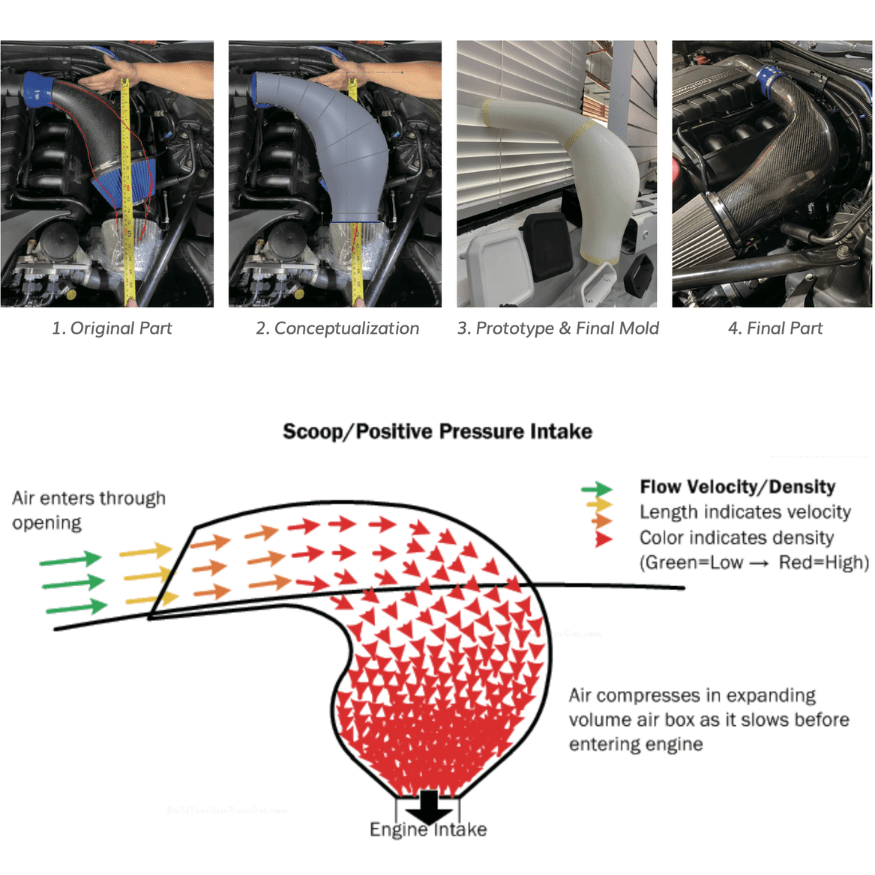
We began with a full onsite inspection to map every clearance, angle and mounting point inside the engine bay. Using these references, we modelled multiple intake concepts in CAD, testing how far we could expand the plenum without creating interference or disrupting the existing airflow path. Once the final geometry was selected, we moved to validation using the UnionTech Lite 600, an industrial SLA machine known for its fine laser spot and smooth surface output. Its 600 by 600 by 400 mm build size allowed us to print the entire intake as a single piece, which ensured accurate internal channels and consistent wall thickness.
We printed the prototype in white ABS-like resin, chosen for its rigidity, stability and ability to reproduce fine details needed for a carbon-fiber master. After printing, we physically checked alignment, sealing surfaces, hose connections and plenum fit. The SLA output matched the engine-bay envelope precisely, so no redesign was needed. With the geometry validated, the printed intake became the master pattern for the carbon-fiber layup, delivering a final part that was strong, heat-resistant and built exactly around the customer’s performance goals.
We followed a structured engineering workflow:
• All measurements were taken onsite using physical references and photographs.
• Multiple CAD concepts were created to test plenum expansion limits and airflow behavior.
• The UnionTech Lite 600 SLA machine produced the prototype using a fine laser beam capable of achieving high accuracy and smooth surfaces ideal for mold creation.
• The 600 by 600 by 400 mm build volume allowed a full one-piece print that preserved the internal geometry.
• White ABS-like resin was selected because it holds fine detail, cures uniformly and is rigid enough to support carbon-fiber layering.
• The prototype underwent thorough physical fitting and clearance checks.
• After validation, the SLA model was used directly as a master for the carbon-fiber molding process.
Every stage was completed with minimal iteration because the SLA output provided a near-final representation of the geometry. This avoided the trial-and-error cycle usually seen in custom intake fabrication.
The redesigned intake showed measurable gains. Experimental studies indicate that increasing plenum volume significantly improves power at higher engine speeds, and this project followed the same trend. In the customer’s case, performance data suggested an improvement of up to 17 percent in peak power when using a plenum size closer to 6.0L compared to a 1.2L configuration.
The increase in air reservoir allowed the engine to maintain higher airflow stability at high RPM. The smooth internal surfaces produced by the SLA process further supported efficient flow.
Most importantly, the SLA prototype eliminated multiple cycles of manual fabrication, saving days of labor and material. The carbon-fiber final part fit perfectly inside the engine bay on the first attempt.
The customer received a custom-built performance intake designed exactly around his engine’s needs, proving the value of combining precision CAD, industrial SLA printing and advanced composite manufacturing.
Explore solutions we've delivered.



