RPS cut automotive customisation costs and reduced lead time from 10 to 2 days using plastic LPBF for series production.
Cost Reduction
Production Time
Faster Delivery Cycle
Rapid Parts Solutions is an automotive manufacturing partner serving Tier 1 automotive companies with rapid prototyping and series production. With over 200 technicians and a facility equipped with CNC machining, SLA, DLP, injection moulding, vacuum casting and industrial 3D printing systems, RPS delivers functional automotive components from concept to production. As EV platforms increased demand for lighter, stronger and customised components in smaller volumes, RPS required a scalable production method that reduced tooling dependency while maintaining industrial-grade mechanical performance.
The development of automotive functional parts, such as HVAC blower motor assemblies, has become increasingly design-intensive, requiring dimensional accuracy, impact resistance, and thermal stability. Traditional manufacturing, such as 5-axis CNC machining and sand casting, has long lead times, high tooling costs, and minimum-batch constraints. Small series customisation became financially inefficient and slowed design iteration cycles.
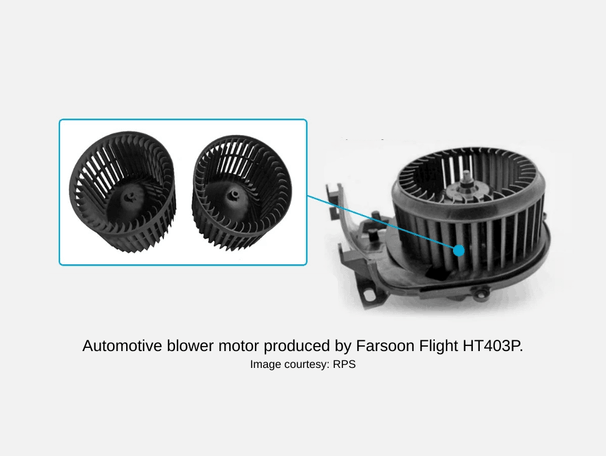
RPS implemented Farsoon Flight HT403P plastic Laser Powder Bed Fusion systems powered by fibre laser technology. Compared to conventional CO2 systems, the fibre laser provided higher power density, improved energy absorption and greater process stability. The open-parameter architecture enabled optimisation of scan speed, layer thickness, and thermal control, while improved nesting efficiency increased build yield and reduced post-processing.
Pilot validation focused on HVAC blower motor components where airflow precision and structural durability were critical. Build orientation and laser parameters were optimised to minimise porosity and ensure consistent layer fusion. The team transitioned from tooling-based workflows to a fully digital CAD-to-build process, nesting multiple parts per build to maximise machine utilisation. Mechanical testing, dimensional inspection and durability validation ensured compliance with OEM functional standards before scaling to on-demand series production.
Production lead time reduced from 10 days to 2 days for a small batch customised series. Manufacturing cost dropped by an average of 90 per cent due to the elimination of tooling, reduced labour intensity and higher production yield per build. RPS improved responsiveness to OEM revisions while optimising the cost-volume curve for low-volume automotive production.
Explore solutions we've delivered.



