Regulator approved 3D printed tantalum spinal fusion cage using metal powder bed fusion for advanced orthopaedic applications
Class III Clearance
Trabecular Porosity
Cage Production
The implementation is of one of Asia's leading medical 3D printing solution providers, with a fully integrated industrial chain covering material research, software development, additive manufacturing and post-processing. The company works closely with hospitals and surgeons to deliver accurate, efficient and clinically validated orthopaedic solutions.
Through this collaboration, the company has consistently pushed the boundaries of metal powder bed fusion for medical use. From knee replacements to spinal fusion cages, the group has pioneered multiple first-of-its-kind implant approvals and surgeries, positioning itself at the forefront of industrial-grade medical additive manufacturing.
Tantalum is widely recognised for its biocompatibility, corrosion resistance and mechanical stability, making it ideal for orthopaedic implants. However, its extremely high melting point, density and elastic modulus make it difficult to process using conventional manufacturing methods.
Traditional routes such as powder metallurgy and electron-beam melting require multiple secondary processes, including deformation, welding, and heat treatment, leading to higher costs, longer lead times, and limited design flexibility. In addition, conventional methods for producing porous implants were limited in customisation and scalability.
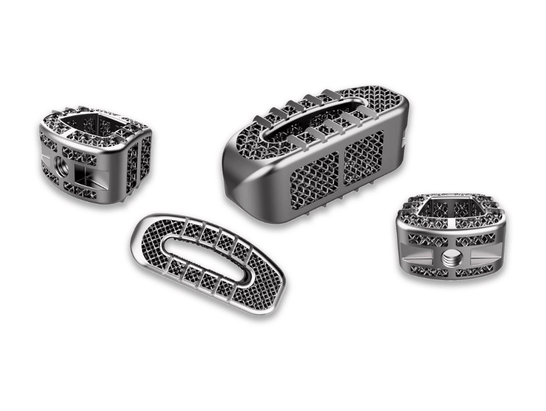
Metal powder bed fusion technology was leveraged to develop a fully additively manufactured tantalum interspinal fusion cage with a clinically optimised porous structure.
Key advantages included:
• Customised implants tailored to individual patient conditions
• Trabecular microstructure with 68 to 78 per cent porosity
• Elastic modulus closely matching human cancellous bone
• High-dimensional accuracy with minimal post-processing
• Strong load-bearing capacity with fatigue resistance
• Improved material utilisation and workflow efficiency
This approach enabled complex geometries and internal lattice structures that were previously impractical or cost-prohibitive.
The process began with digital modelling of the fusion cage, allowing precise control over geometry, internal porosity and surface roughness. Using metal powder bed fusion, pure tantalum powder was processed layer by layer under tightly controlled parameters to achieve structural consistency and mechanical performance.
Post-processing was kept to a minimum due to the accuracy of the printed components. The implants were clinically validated and submitted for regulatory approval, culminating in Category III medical device clearance from China’s National Medical Products Administration.
Clinical applications demonstrated immediate load-bearing capability, mechanical stability and enhanced bone in-growth through the porous architecture, reinforcing the clinical value of additively manufactured tantalum implants.
The project marked the first tantalum orthopaedic implant approved by the country's top regulatory agency, produced using metal powder bed fusion technology. It also established a new benchmark for advanced implant manufacturing.
Beyond regulatory approval, the solution delivered reduced lead times, improved cost efficiency and scalable customisation. Combined with the company's broader track record of over 14,000 customised surgical guide cases and multiple world-first implant procedures, the case demonstrates the maturity of metal additive manufacturing in high-performance medical applications.



